 Re'Mi Music
2 min read
The physics your ears already know
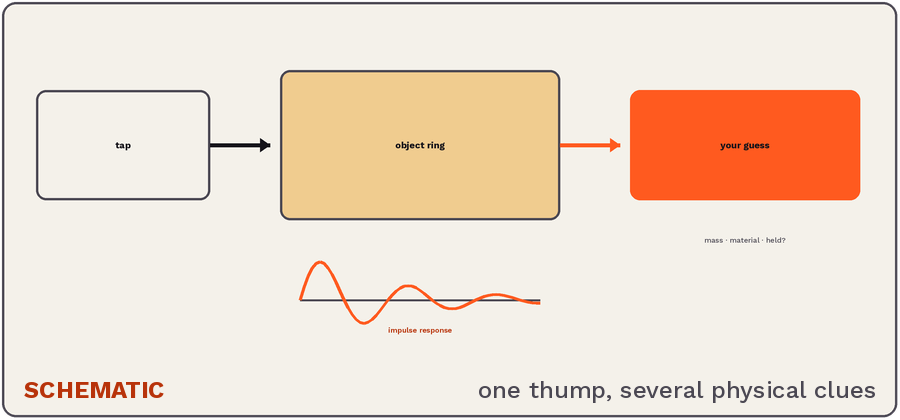
There's a small magic trick your ears do every day. Something thumps in another room, and before you look you already have a guess: a ball, a plate, something soft, something hard. You might even sense how big it was.
I always thought that was just practice. A new study published in PNAS, covered by MIT's McGovern Institute yesterday, suggests our brains carry an internal sense of how the real world makes impact sounds. We use it to pull several physical facts out of a single noise.
Josh McDermott's team, with first authors Vinayak Agarwal and James Traer, started by asking people what they had recently heard being dropped, struck, tapped or scraped. From those answers they chose more than 400 everyday objects and measured each object's impulse response—how it vibrates after a short push. Those measurements let them build collision sounds that either followed the patterns of real objects or broke them on purpose.
Then they gave listeners two jobs. First: which of two falling balls was heavier, even when the balls hit different surfaces, like plastic and ceramic? People usually got it. Second: was the object they heard being struck sitting on a table or held in someone's hands? A hand absorbs much of the vibration, so the ringing fades sooner. Listeners usually heard that difference too, even without knowing the material.
When the team made the vibrations behave unlike those of real objects, listeners struggled. That suggests we rely on patterns learned from the sounds around us. McDermott even wonders how much of that learning happens when children bang things together.
As a sound designer, I find that fascinating. An everyday thump carries clues about weight, material and touch—and we can interpret them without stopping to think.
Your ears aren't only hearing a thump. They're using what you've learned about how the world rings.
Source: Sound intuition — MIT McGovern. https://mcgovern.mit.edu/2026/11/06/sound-intuition/