 Re'Mi Music
2 min read
When the cone tells on itself
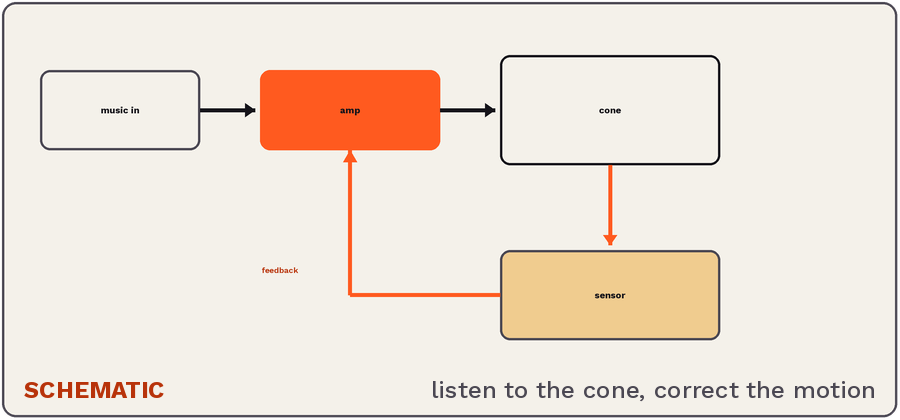
There's a quiet truth every sound person learns the hard way: you can make a frequency-response graph look beautiful and still hear something wrong.
EQ and room correction reshape the signal going into a speaker. They don't know what the woofer cone is actually doing once it starts moving. Push it hard and you get excursion distortion, port chuffing, and electrical mess from a voice coil that changes as it heats and slides. The graph can look flat. The cone can still lie.
This week I read about KEF bringing an old answer back into a modern wireless speaker, the LS LUXE. They call it Velocity Control Technology, or VECO. Inside the woofer motor sits a tiny passive motion sensor — a sensing coil printed onto a flexible board that replaces the usual voice-coil former, with roughly 55 metres of track folded into that small space. It watches how fast the cone is moving and feeds that into a negative-feedback loop around a custom current-drive amplifier. When the cone drifts from what the music asked for, the amp nudges it back. In KEF's own level-matched tests at about 84 dB SPL at one metre, they report 8 to 10 dB more output below 40 Hz than the LS50 Wireless II, and total harmonic distortion down by 6 to 14 dB through the bass and midrange.
The idea isn't new. In the early 1970s Philips built Motional Feedback speakers with a piezo accelerometer under the dust cap. They were good enough for serious studio work — according to the write-up, Pink Floyd mixed The Wall on Philips RH544s. The approach mostly faded. The systems were complicated, and a sensor small and fast enough to live inside a modern driver motor without adding lag was hard to find. VECO first showed up in KEF's XIO soundbar in July 2025; the LS LUXE followed in 2026 after what KEF describes as six years of work since the LS50 Wireless II.
I like this story less as a product launch and more as a reminder. We're still learning how to listen to the thing that's making the sound, not only to the signal we send it. Old questions don't expire. Sometimes they just wait for better tools.
Takeaway: EQ reshapes the request. Listening to the cone reshapes the answer.
Source
Headphonesty: KEF revives a forgotten 1970s speaker technology to fight distortion no EQ can fix